
News
Event Update
AI Brings Risk and Opportunities to Communications - So What Can We Do About It?
Communication is the last mile of trust. No matter how sophisticated the technology behind an idea, if you cannot explain it in plain English, the idea does not penetrate.
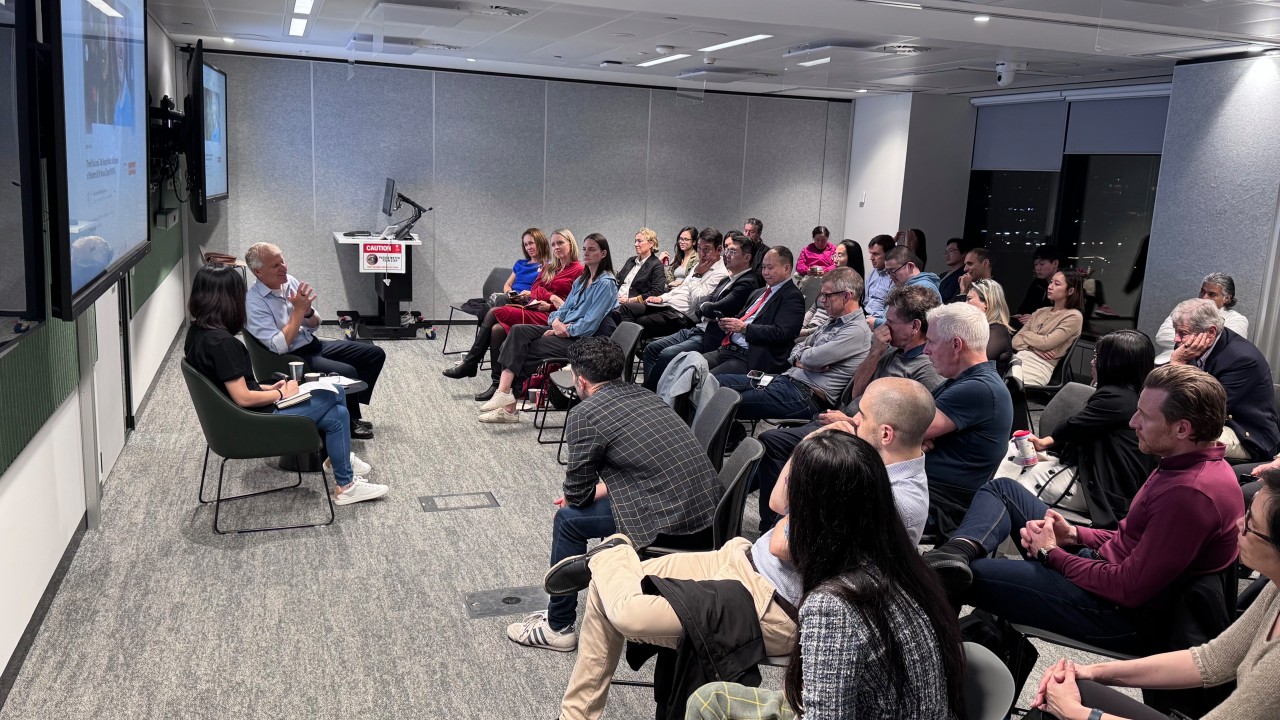
That was the thread running through last night's Think Fast Talk Smart event at the University of Wollongong, hosted by the Stanford Australia Association and the collective alumni of International Business Schools. I was proud to bring together Matt Abrahams, lecturer in strategic communication at Stanford University Graduate School of Business, and Dr Susan Zhang PhD EMBA, who leads start-ups and VC for NVIDIA across Australia and New Zealand.
Matt is the host of the podcast Think Fast, Talk Smart, downloaded by millions of listeners around the world, and the author of Think Faster, Talk Smarter and Speaking Up Without Freaking Out. Matt has spent his career studying the mechanics of spontaneous communication, how we organise our thoughts under pressure, manage anxiety in the moment, and speak with clarity when there is no script to fall back on. He named something most of us feel but rarely say aloud: 85 per cent of people are nervous in high-stakes settings, and the other 15 per cent are probably lying. His answer is not to eliminate the nerves but to manage them, with a simple structure, What? So What? Now What?, to keep communication clear instead of collapsing into what he calls "AI slop." Anxiety, he argued, is fear of a future outcome, so the antidote is presence: a roadmap over a script, a breath held twice as long on the exhale as the inhale, a cold drink in hand. Matt also recommended the What? So What? Now What? framework to package information concisely.
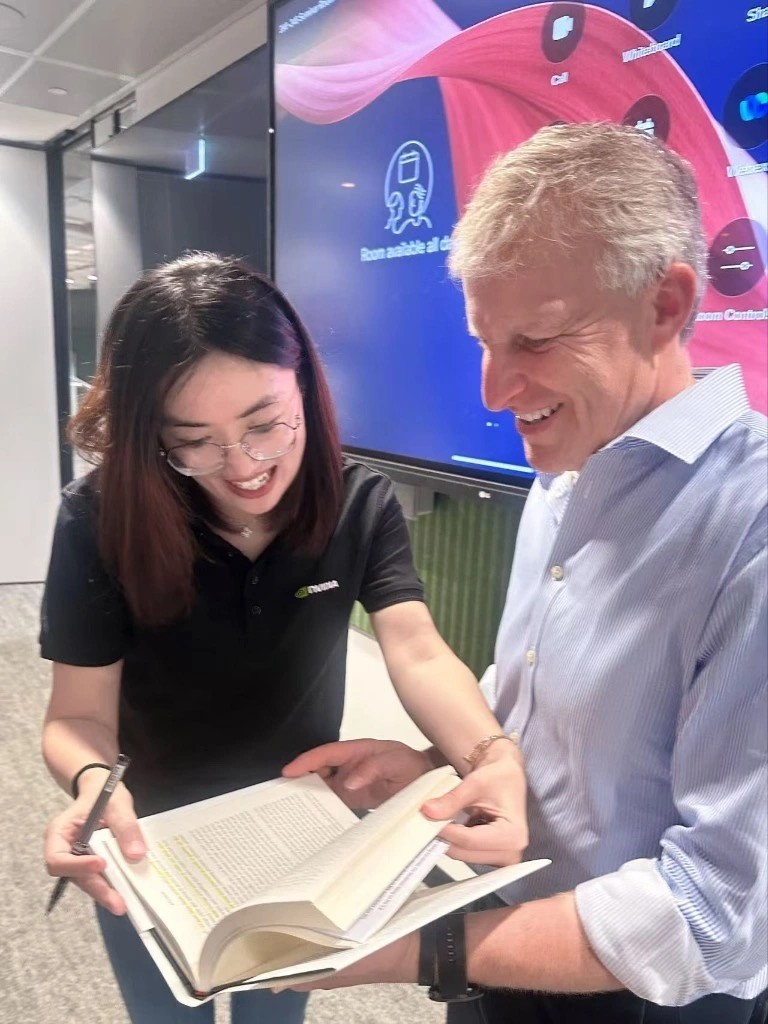
Susan brings experience from NVIDIA, Canva, Google and TikTok before her move into the AI and venture ecosystem. She is a TEDx speaker, a published author twice over, and a recognised voice on where artificial intelligence is taking communication, education, and the startup landscape here in Australia and globally. Susan brought the founder's view. In the NVIDIA Inception program, she said, the differentiator is never the polished AI-generated deck. It is a founder's ability to explain a hard technical problem the way you would to your grandmother. She also named a risk worth sitting with: the empathy paradox. AI can be a genuine thought partner, sharpening our blind spots before a difficult conversation. But if it is relied upon too heavily, it produces empathy atrophy, where we outsource that reflection that real connection depends upon.
Two different disciplines, one shared conclusion. As AI accelerates every part of business, education and start-up life, the founders and leaders who will lead are the ones who stay most human and authentic in how they communicate. We must all keep investing in that human skill deliberately and not assume it will automatically look after itself.
Communication Frameworks & Anxiety Management
- Presence-Oriented Tactics: Anxiety often stems from fear of a future negative outcome. To ground yourself in the present, use vocal warm-ups or tongue twisters (e.g., "I slit a sheet, a sheet I slit...") to occupy cognitive bandwidth and prevent future-tripping.
- Anti-Memorisation: Rote memorisation increases cognitive load and anxiety. Use a "roadmap" of key points rather than a script to remain agile and connected to the audience.
AI, Authenticity, and the Startup Ecosystem
Dr Susan Zhang provided a front-row perspective on AI native startups and the leadership required to navigate global teams.
- The 80/20 Rule of Risk: Zhang highlighted that waiting for 100% certainty often means the opportunity has passed. Operating at 80% certainty allows for agility and market leadership.
- Authentic Pitching: For founders in the NVIDIA Inception program, the differentiator is not a polished AI-generated slide deck but the ability to explain complex technical problems in "plain English" (e.g., explaining the cloud to a grandmother).
- The Empathy Paradox: AI can be a "thought partner" to challenge blind spots and help plan difficult conversations. However, over-reliance leads to "empathy atrophy," where users outsource the deep reflection required to truly connect with others.
AI in Education and Parenting
The panel also discussed the shift from AI as a "cheat code" to AI as a pedagogical tool.
- Dialogue over Synthesis: Professors are moving away from asking students for summaries (which AI does well) toward using AI as a "sparring partner" for dialogue and case study interrogation.
- The Credibility Shift: Zhang noted technology is reshaping family dynamics, where children may fall into trusting AI assistants for objective facts (e.g., weather-appropriate clothing) more than parental advice, shifting conflicts from personal to technological.
- Token Dynamics: The future workforce will be divided into "token producers" and "token consumers." The goal for educators is to ensure students remain critical thinkers who use AI to stretch their habits into deliberate choices.
Thank you, Matt and Susan, for a genuinely valuable evening for our Australian alumni, and guests and our start-up community.
Tony Surtees, AM
President, Stanford Australia Association
25 August 2026

In Memorium
Vale John Walton, AM
Australia has lost one of its most versatile business figures. John Walton AM has passed away, and with him goes a career that shaped retail, finance, health administration and heritage in this country across five decades.
John built and chaired an extraordinary breadth of enterprises: Waltons Limited, FNCB-Waltons, Waltons Insurance, Barclays Credit Corporation, Burson-Marsteller Australia, Jardine Insurance Brokers, Mark Foys and Miller Anderson among them. He chaired the Australian Retailers Association and the Retail Traders Association of New South Wales, giving voice to an industry he understood from the inside. He led the Eastern Sydney Area Health Service and the Prince Henry Centenary Research Foundation, and served the Prince of Wales Medical Research Institute and the Sydney Children's Hospital Foundation, work that reflected a conviction that commercial success carries a civic obligation. He chaired the Australiana Fund and the Official Establishments Trust, guardianship of the material culture that tells our national story. He sat on the boards of the Australian Institute of Management, the Confederation of Australian Industry, and the Sydney Committee, and gave his time to the Young Presidents Organisation, a Stanford MBA connection that shaped his later work at Walton Enterprises, the boutique advisory firm he chaired and through which he counselled clients including PBL, Davids Holdings, Manildra, Pace Farms and GJ Coles. In 1977 he received the Queen's Silver Jubilee Medal.
In 1998 he was made a Member of the Order of Australia for services to the community, in particular to public health administration and Australian heritage, a citation that captures the man well: commerce and community, held together without contradiction.
I knew John as a fellow board member and colleague on the Stanford Australia Association committee, where we served together for 33 years. Long after his own MBA years, John remained one of the Stanford Australia community's most committed supporters, giving generously of his time and standing to keep the alumni network strong and connected across generations. That kind of loyalty to an institution and its people says as much about a person as any boardroom title, and John carried it quietly and consistently, year after year.
Vale, John Walton. A career built on the belief that boardroom judgement and public service are not separate callings but the same one, and a friendship I was privileged to share for over three decades. Our thoughts are with his family and the many organisations and communities he served.
- Tony Surtees, AM
President, Stanford Australia Association
